
Choosing what we carry forward
In recent weeks, global attention has once again turned to the inner workings of professional kitchens with Noma head chef, René Redzepi, resigning amid abuse allegations. Conversations around demanding environments, long hours and, more critically, the emotional and verbal experiences of those within them have resurfaced. For many, this has confirmed what has long been accepted as “part of the industry” — that kitchens are tough, high-pressure spaces where intensity often spills over into how people speak to one another.
At the Institute of Culinary Arts, we acknowledge this reality. Professional kitchens will always demand precision, urgency and resilience. They are, by nature, environments where standards are high and the margin for error is small.
But demanding need not mean demeaning.
Excellence does not require harshness. And importantly, words — what we say, and how we say it — carry lasting weight.
Science supports what many of us intuitively know: the human brain is wired to hold onto negative experiences more strongly than positive ones. Psychologists refer to this as the “negativity bias” — a survival mechanism that prioritises potential threats. In practical terms, it means that a single harsh comment can linger far longer than multiple words of encouragement. One sentence, spoken in haste, anger or frustration, can shape how a student or employee sees themselves for years to come.
And yet, the opposite is equally true: One sentence, offered with intention, can change the course of a life.
Over the years, the Institute of Culinary Arts has been privileged to witness the profound impact of words — spoken at the right time, in the right way.
ICA Head of Cooking and Chef Lecturer, Pierre van Zyl (ICA Class of 2006), recalls Principal Letitia Prinsloo’s words to him during his studies — words that have come full circle, as he now stands in the very kitchens where he was once a student: “We will make a chef out of you, yet.” It was a statement of future belief — simple, direct and lasting.
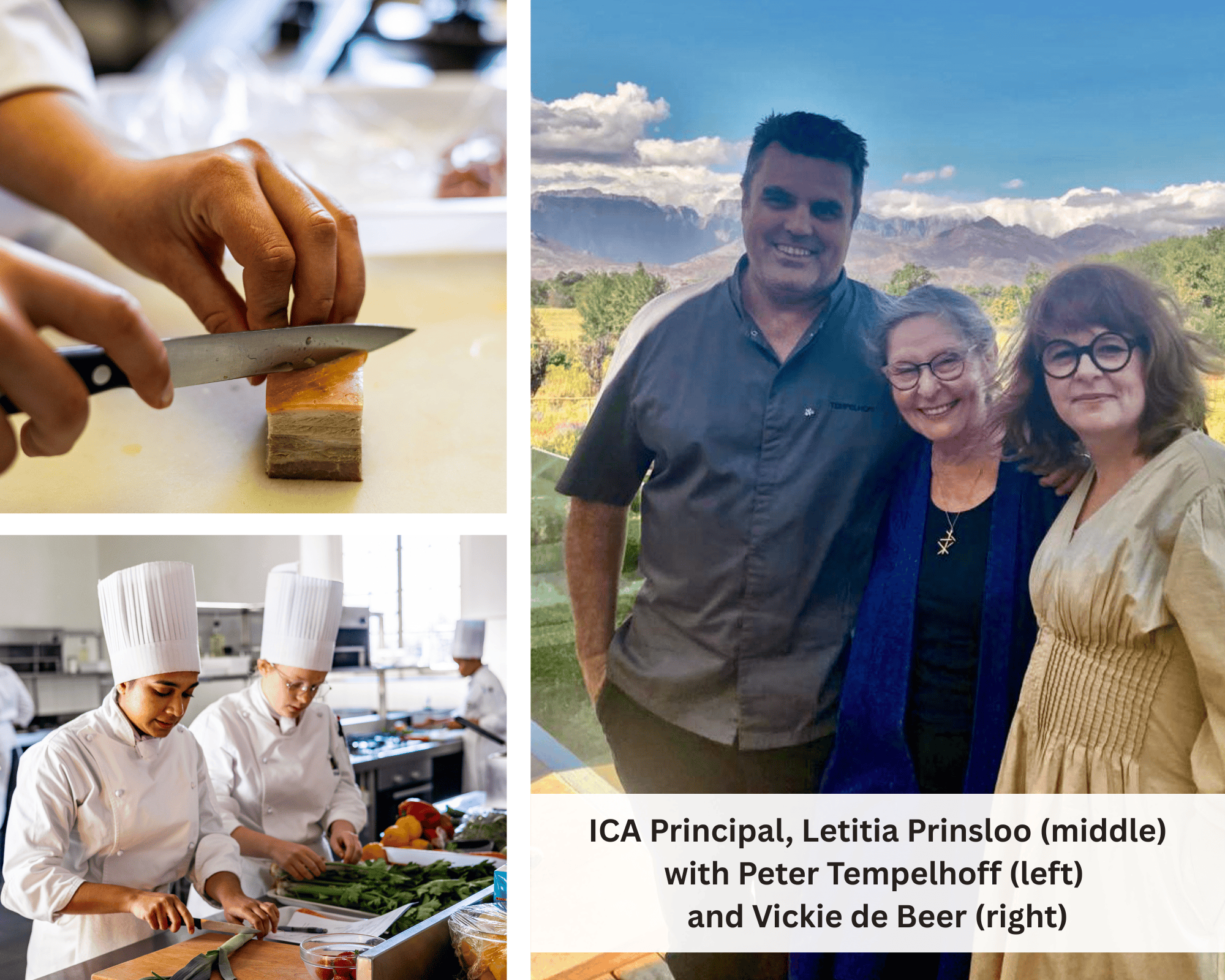
For Vickie de Beer (ICA Class of 1997), former Rooi Rose Food Editor and multi-award-winning cookbook author, those early words became an anchor. Years after graduating as part of ICA’s very first intake, she found herself in a foreign country, working on a book, feeling alone and disconnected from the culinary world she once knew. In those moments, she returned to a phrase instilled during her studies: “Our aim is perfection.” Those words carried her through — not as pressure, but as purpose.
Peter Tempelhoff (ICA Class of 1997) that was awarded the EAT OUT award – FYN: Restaurant of the year 2026. He still recalls, with a gentle laugh, how Letitia used to say that ICA students are “cut from a different cloth” than their peers. Today, that sentiment is reflected in the calibre of ICA graduates have gone on to lead, innovate and shape the industry both locally and internationally.
Sometimes, it is not the big speeches that matter most, but the quiet moments. At a recent graduation ceremony, a mother approached Letitia to share how just a few words had helped her son persevere through a particularly challenging ICA exam. A small gesture, a reassuring pat on the back and a simple sentence: “You’re going to make it.” In that moment, the words mattered more than the result.
Even Letitia Prinsloo’s own journey was shaped by words that stayed. After completing her studies under the world-renowned Roger Vergé, she was privileged to dine at his restaurant in France. When he approached her table, she was struck by the humility in his response: “But ma’am, I’m here to serve you.” A statement that redefined excellence through service — and a philosophy that continues to underpin what it means to be a chef.
Hylton Espey (ICA Class of 2003), reflecting on his own career and the discipline that defines it, recalls a formative lesson from his early days at ICA: “Walk like a chef.” When asked by AA Restaurant Awards organisers how he consistently arrives early, prepared and impeccably presented — even after long hours on the line — his answer is simple. The ICA instilled in him discipline, work ethic and pride in the profession. On campus, students were taught: “Be proud, walk with purpose and look the part.” Years later in his career, he still arrives in a crisply ironed white jacket, maintaining that standard from the first hour of service prep to closing time.
To this day, a phrase often repeated in ICA’s training kitchens — and one Letitia herself continues to carry in her own kitchen — is: “Keep your eyes and your mind on the job in front of you.” It is taught during first-year knife skills sessions, where focus is not optional; it is practical, grounding and essential. It teaches presence — and, quite literally, prevents injury.
Language, in this context, becomes more than instruction. It becomes culture.
At ICA, this culture is intentionally shaped. During training, the kitchens are structured, focused and professional. Instructions are acknowledged with a unified “oui, chef” — a sign of respect, attentiveness and readiness to act. Yet there is also balance. On Fridays, music plays in the cooking kitchen, and the atmosphere softens slightly. The standards remain, but the environment reminds students that discipline and enjoyment are not mutually exclusive.
This balance is essential. Because while we prepare students for the realities of the industry, we also equip them to influence it.
It is important to recognise that while words can wound, individuals also hold agency in how they receive them. Growth often requires the ability to discern — to take what is constructive, and to release what is not. This is not always easy. It takes maturity, self-awareness and practice. But it is a powerful skill: the ability to choose what we carry forward.
At the same time, this responsibility does not excuse poor conduct. The onus remains on industry leaders — chefs, mentors, educators — to communicate with intention, to correct without belittling, to guide without diminishing and to lead in a way that builds, rather than breaks.
Because long after the words themselves are forgotten, the feeling remains.
A recent article by ICA graduate Kobus van der Merwe (ICA Class of 1999), published in the Daily Maverick, reflects on the enduring legacy of kitchen culture and the urgent need for change within the global culinary industry. His perspective, shaped by both experience and reflection, highlights how deeply ingrained behaviours — often normalised over time — continue to affect those working within professional kitchens. Yet, importantly, it also points toward a shift: a growing awareness that excellence and respect are not mutually exclusive. This is precisely where the Institute of Culinary Arts positions itself. ICA does not deny the realities of the industry; rather, it prepares students to enter it differently — equipped not only with technical skill, but with a mindset grounded in self-awareness, respect and responsibility. Our graduates carry with them not just the discipline to perform, but the discernment to lead — to question outdated norms, to communicate with intention, and to contribute to a culinary future that values both excellence and humanity.
At the Institute of Culinary Arts, we are committed to developing chefs who understand this. Chefs who recognise that respect is not a compromise on excellence, but a foundation for it. Chefs who will go on to run kitchens where high standards and human dignity exist side by side.
The culinary industry will always be demanding. It will test endurance, patience and skill. But it is also an industry built on care — for ingredients, for guests, and ultimately, for one another.
Words are part of that care. They shape environments, they influence confidence, and they most definitely leave marks — both visible and unseen.
Each of us, whether speaking or listening, holds a choice to use words that build, to hold onto those that strengthen and to let go of those that do not.
Because in the end, it is not only what we create on the plate that defines us, but how we make people feel along the way that shapes the industry for the next generation to step into.