

Training for Global Excellence
The core culinary education philosophy at ICA is based on excellence with depth, discipline and relevance.
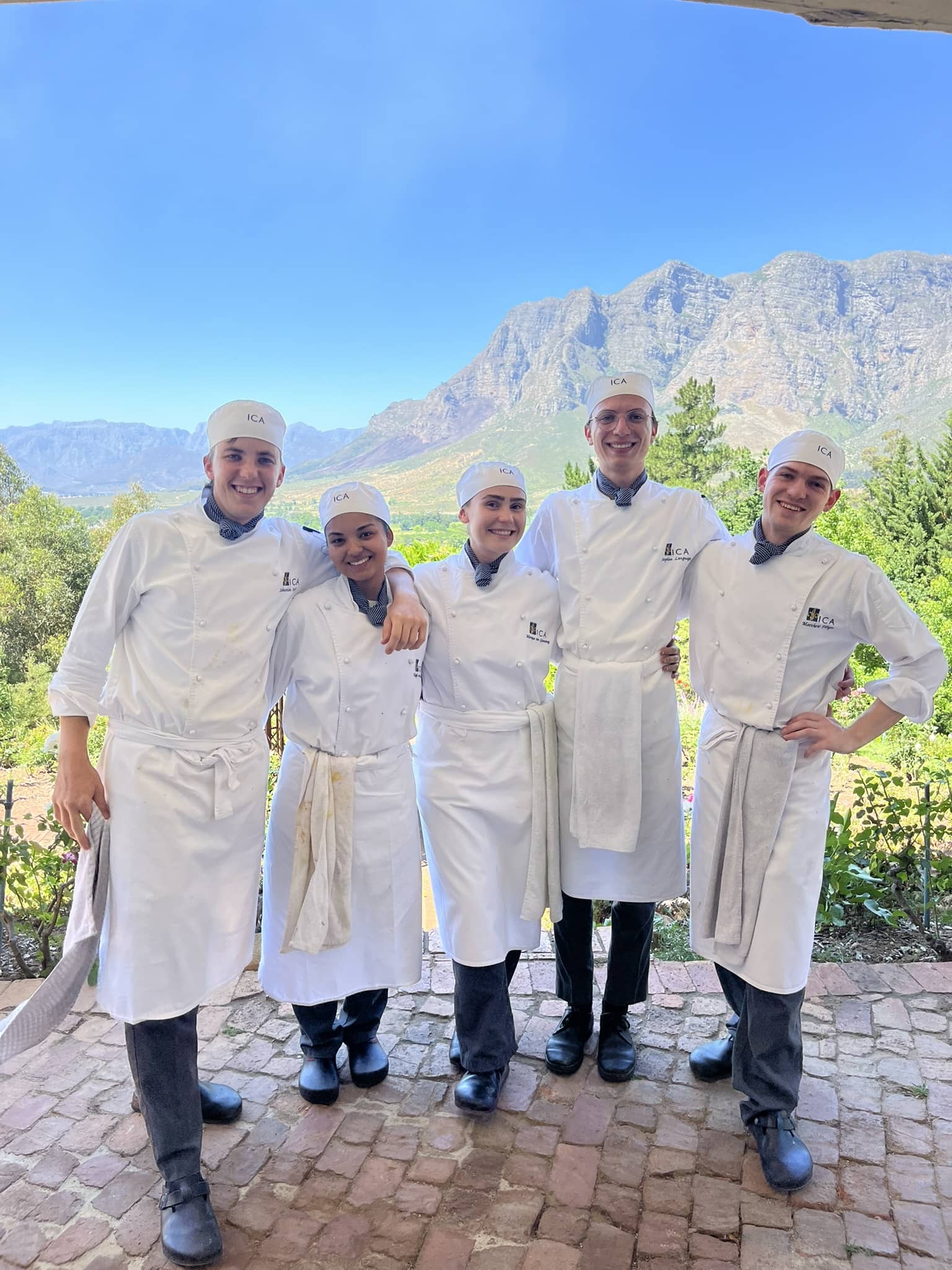
Students are taught why techniques matter, how to apply them (even and especially under pressure) and where they fit into the bigger picture of a professional kitchen brigade. From their first day on campus, students get immersed in this structure, learning to operate within it, understand the dynamics of a high-functioning kitchen and respect every role it offers. It’s about more than technique; it’s about professionalism, humility and the ability to seamlessly slot into any position where they are needed.
ICA’s meticulous training ensures that when graduates enter professional kitchens, they arrive not as novices needing guidance, but as valuable contributors who are fluent in the language of professional cooking and pâtisserie. Whether it’s an award-winning fine dining establishment in Cape Town’s bustling city centre, a contemporary bistro in Lima or London, or a Michelin-starred kitchen in New York, Copenhagen or Milan – ICA alumni are ready and can be found in such world-class establishments, locally and abroad.
This readiness is no accident. It is driven by ICA’s uncompromising commitment to global culinary excellence, the motivation for the school’s inception 30 years ago.
Principal Letitia Prinsloo, who served on numerous elite restaurant judging panels (including the coveted S. Pellegrino World’s 50 Best Restaurants Awards) brings a wealth of insight into what it takes to stand out on the international stage. Her vision is both expansive and exacting: “At the ICA we insist on excellence, but also on relevance”.
To maintain that standard, Letitia routinely travels to dine at some of the world’s finest restaurants. These culinary pilgrimages are a vital part of ICA’s educational strategy. The knowledge gained from such dining experiences and personal encounters with the world’s best chefs is brought back, contextualised and translated into practical training for ICA students.
This means that ICA’s teaching is not only informed by tradition, but also by the latest industry developments and global trends. Through in-depth study of the Masters, students are exposed to evolving techniques, flavour profiles, plating styles, sustainability practices and service expectations that are shaping modern gastronomy. Students develop a profound appreciation for the science and art of gastronomy as a global trade. As a result, they graduate with both a solid classical foundation and the versatility to adapt to any culinary environment.
ICA’s reputation for producing world-class chefs is supported by the success of its alumni, many of whom have gone on to work under the direction of international culinary icons such as Marco-Pierre White, Jamie Oliver, Heston Blumenthal and Thomas Keller, to name but a few. These are not easy kitchens to enter, let alone succeed in, yet ICA graduates consistently rise to the occasion. Their ability to hold their own in these prestigious environments speaks volumes about the calibre of education and mentorship they receive at ICA.
Once graduated, it is on entering kitchens of the highest caliber that ICA alumni realise the superior level of their own training. Here, in the professional work environment is where they fit in because it is familiar and it is the culmination of years of training.
Stephanie Hodgson (ICA Graduate 2024) was recently offered a position at a prestigeous London restaurant. She had such an insightful realisation, she sent a personal message to one of her former lecturers at the ICA:
“I had a realisation the other day. ICA trains people for this [international kitchens]. From our uniform to presentation [on the plate] – it has the exact same rules as ICA, so [to me,] it is second nature. The way everyone carries themselves, is incredible.”
What sets ICA apart even further is its insistence on holistic, integrated training. Cooking and pâtisserie are treated not just as skills, but as disciplines that require creativity, precision and emotional intelligence. The school’s curriculum is deeply based in theory and supported by intensive hands-on training. Beyond the campus training kitchens, practical placement blocks offer real-world exposure that is critical to building the kind of confidence and competence that employers look for.
A strong culture of mentorship further enhances the ICA experience. Faculty members are carefully selected for their industry experience, passion for teaching and commitment to student success. Every student is seen, guided and challenged to achieve their personal best. The environment is supportive but uncompromising: excellence is expected, and growth is continuous.
This is why ICA has earned its place as the top culinary school in South Africa — a distinction based on measurable outcomes, as is evident in its alumni’s recent accumulation of no less than 21 Eat Out Star Awards. ICA is a chef school where talent is nurtured, discipline is instilled and global standards are the norm.
For aspiring chefs who dream of cooking on the world stage, ICA offers more than just training — it offers transformation. It is the bridge between ambition and achievement, between learning the basics and mastering the extraordinary.
When ICA students graduate, they carry with them a legacy of excellence, a toolkit of world-class skills, and the quiet confidence of knowing that they are ready — truly ready — to take their place among the best, locally and overseas.
Interested in applying to ICA or learning more about our internationally accredited programs?
Click here to take your first step toward a global culinary career.